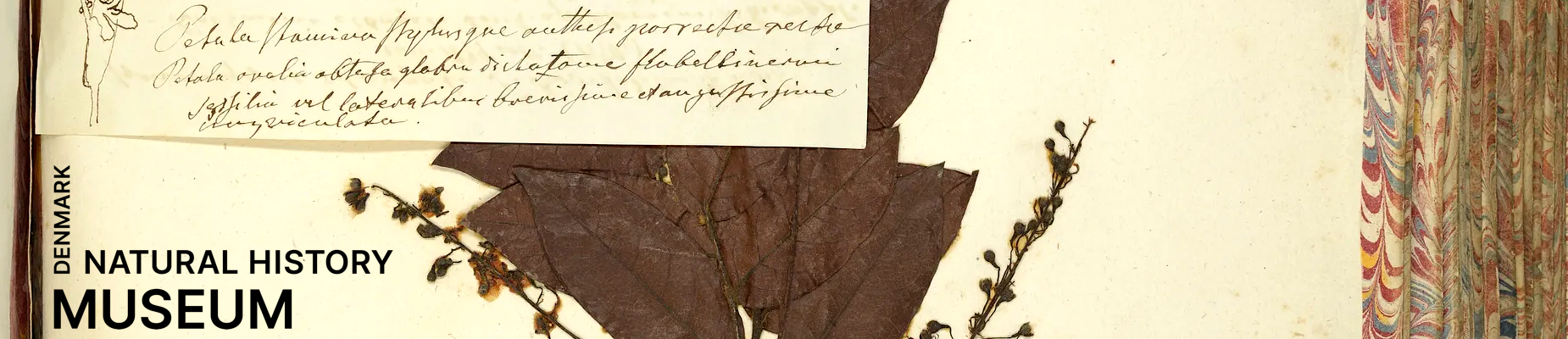
Fagara zanthoxyloides Lam. [Rutaceae]
Item
- Botanical Name
- Fagara zanthoxyloides Lam. [Rutaceae]
- Specimen Type
- Herbarium Sheet [Preserved Specimen]
- Collector
- Peter Thonning
- Collection Date-s
- 1799 – 1803
- Collection Location
- southern part of the country [Ghana]
- Colonial Context
- Danish Gold Coast of Africa 1663–1865
- Annotations Determinations and Type Specimen Status
-
On sheet: HB. SCHUM. 46. Fagara zanthoxÿloides Wild: Zantoxÿlum V. polygamum m: Collect: Guin:
D. Th.
IDC microfiche foto: Isert et Thonning nr. 111 III 3-4
Zanthoxylum polygamum Schumach. and Thonn. SYNTYPE. Beskr. Guineiske Pl.: 433 (1827) - Ownership and Collection Management History
- Thonning 46; ex herb. C. F. Schumacher
- Common Names
- Hah-tio [Schumacher/Thonning]
- Historical Cultural and Traditional Knowledge
- [Hepper (1976) pp. 113-114:] "Near the coast; where the sea wind subjugates most plants with its destructive fog from the sea-water which it bears from the surf; it never reaches its natural size but remains as a shrub; the farther from the shore the better it thrives; 3-4 miles inland trees occur the size of average oaks; whose trunks also resemble them in figure and extent. The wood has various features which make it serviceable for furniture-work; it is strong; hard; heavy; a more beautiful yellow in colour than box but like this it later loses its yellow colour; it is as fine as the average kind of mahogany; it contains much resin which is so well distributed that it does not exude from the tree when it is worked as timber but on the contrary causes it to assume a shiny and fine polish; I have never found it attacked by worms; it is frequently interspersed with knots. As an average size of planks which this tree is capable of yielding one may assume 5 to 8 inches in breadth and 2 ells in length; selected trees may perhaps yield planks of 12 to 16 inches in breadth but hardly more than 2 ells in length as the trunk is generally twisted and curved. The bark of the root is used by the natives to expel gout-pains; along with grains-of-Paradise [Aframomum] it is finely grated and rubbed on the painful place. From the wood especially the knotty kind torches are made which are generally used for lighting amongst the poor people. From the prickles on ageing trees bullet moulds are made with carved ornaments for printing with colour on the body. In toothache the finely ground root bark is rubbed in externally on the cheek and a decoction is now and then applied to the teeth. Th."
- Source
- Herbarium C NHMD
- NHMD Herbarium C Catalogue Number
- C10004725
- C10004725
- Copyright Owner
- Natural History Museum of Denmark
- Copyright License
- CC BY 4.0 (images) and CC0 (metadata)
Position: 811 (5 views)