How to Read a Herbarium Sheet
Herbarium sheets are unusual as biocultural records in that the basic crucial information (in biological research terms) is often written on the very sheet itself to which the dried plant specimen is attached. This constitutes part of the historicity of the herbarium sheet as a phenomenon. The earlier in time that the material has been collected, the less likely it is to have even basic information like the date/year, exact locality (other than country name - such as 'India'), or other information. The development of the standardisation of these data (what counts as information at any given period in time) is a significant open question in the history of science and philosophical epistemics.
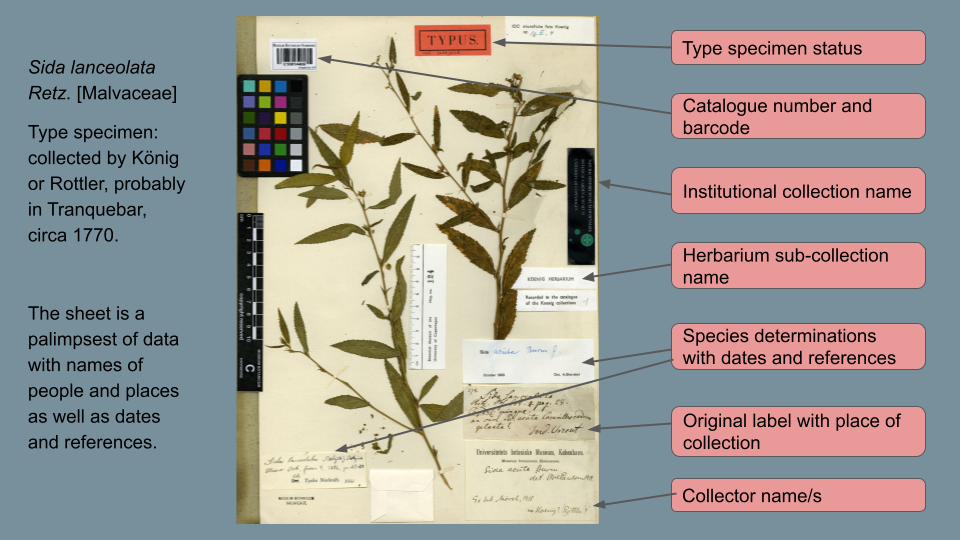
The information elements vary widely from specimen to specimen, look different from sheet to sheet, and change over time, but generally can include:
-
The collector’s name (can be abbreviated)
-
The place of collection (often historical place names that may have changed)
-
Collection habitat information (for example: growing in a wood, in a marsh, south-west facing, etc.)
-
Collection date – year, month, day – with year being most common, especially with 17th and 18th Century specimens
-
Name of the person or people who have held that specimen in their working herbarium as botanists and would have used the specimen in some way to produce different kinds of knowledge
-
Determinations: this is the signed accreditation of different botanists over time ‘determining’ or verifying that this specimen truly is a voucher for a specific species: there are often layers of determinations that change over time, as the agreed names for these species change with taxonomic advances, and they can be in handwriting and/or on printed labels affixed to the sheet – note that the collector is not often the same person as the ‘Author’ – or 'determiner' – of the species
-
Type Specimen Status – if the specimen is one which has contributed to the identification of a new species and its naming, that status will be marked on the herbarium sheet, sometimes with a red label stating 'Type'
-
Ownership, catalogue and reference numbers – this can include multiple numbers for earlier catalogues, including collectors' own handlists made at the time of collection
-
Stamps that indicate that the specimen has been loaned out to other researchers in other institutions – most museums keep a loan book that will show when, who, where the specimen has been loaned out
-
Measurement and colour indicators (specifically for use in photographic and digital images)
-
Barcodes that can relate to digital imaging processes, genomic sampling processes and other kinds of ‘links’ to metadata, some of which may not be on the sheet itself
-
Marks that indicate that the sheet has been treated with pesticides (‘forgiftet’) which can be mercury or other poisons
-
Older paper (‘laid paper’ made from beaten cloth) can bear watermarks that give important ‘ante quam’ information and can be helpful with dating specimens that are so early that they do not have dates on them
Specimens can and have been removed from their original paper supports and re-arrayed on paper deemed less acidic or more likely to preserve the specimen better. In these cases, earlier notation on the original paper mount is usually (but not always) cut out and stuck down to the new sheet, leaving a palimpsest of paper historical information. This leads to complex intermedial objects, with labels, plant matter, photocopies, manuscript markings, photographs, stamps, and traces of evolving media and botanical practices, and more.