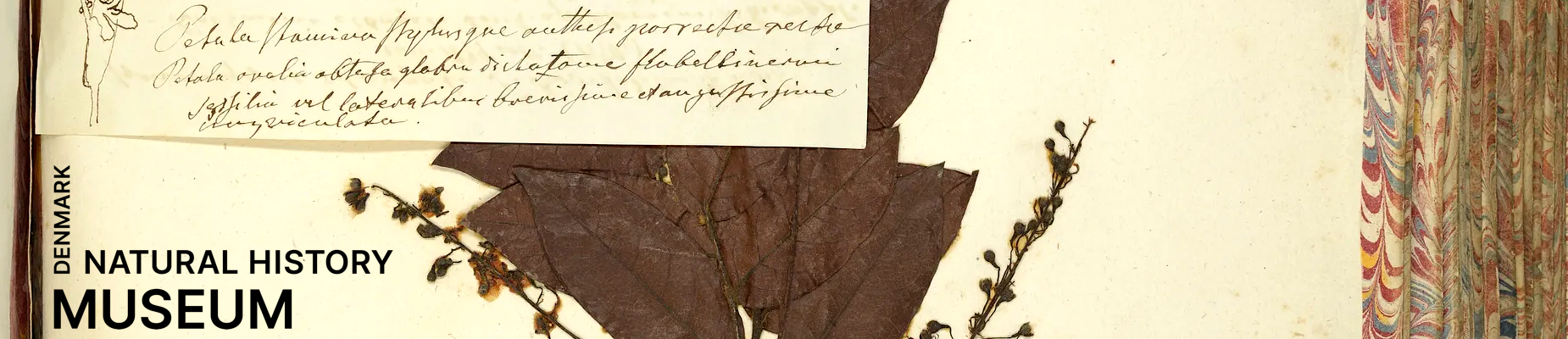
Phoenix reclinata Jacq. [Arecaceae]
Item
- Botanical Name
- Phoenix reclinata Jacq. [Arecaceae]
- Specimen Type
- Herbarium Sheet [Preserved Specimen]
- Collector
- Peter Thonning
- Collection Date-s
- 1799 – 1803
- Collection Location
- southern part of the country [Ghana]
- Colonial Context
- Danish Gold Coast of Africa 1663–2022
- Annotations Determinations and Type Specimen Status
-
On sheet: e Guinea Thonning ?? 1814.
Label1: Phoenix spinosa Thonn. (specimen typ.) = Th. reclinata Jacq. O. Becc. det. 1908
Label2: Seen for Revised Edition of F.W.T.A.
IDC microfiche foto: Isert et Thonning nr. 80 III 1
Phoenix spinosa Schumach. and Thonn. SYNTYPE. Beskr. Guineiske Pl.: 437 (1827) - Ownership and Collection Management History
- Thonning 101
- Common Names
- Akoteno; Amitjolobi (fruit) [Schumacher/Thonning]; Uaegte vin palme; Söd vin palme [Danish]
- Historical Cultural and Traditional Knowledge
- [Hepper (1976) p. 156-157:] "The juice of this palm is far sweeter but less fermented than that of the true wine-palm (Elais guineensis) but where this latter cannot be had one has to be satisfied with the former. They tap the sap in the following way: when the tree has reached a man's height or somewhat over the leaves are cut off close to the trunk; about the 8th day after the top is cut off and the sap which therefore wells out is conducted in a curved tube to a bottle or calabash which is tightly fixed to the trunk; a new cut must be made every day as the old orifices get stopped up; when the tree will yield no more sap of itself a fire is lighted at the lowest part of the trunk and this drives the remaining sap upwards and completely exhausts the tree. Most natives on the Rio Volta suffer much from tumours (hydrocele) which are often extremely large; it is attributed to this drink but might as well be caused by their low-lying and damp country which at one time of year is almost entirely flooded; or to their immoderate pytto drinking (many natives may drink 16-24 pots of pytto a day). Cords are plaited with the young leaves and they prove fairly strong. The fruit has a very light and sweetish pulp; it is called Amitjolobi.
- Source
- Herbarium C NHMD
- NHMD Herbarium C Catalogue Number
- C10004328
- C10004328
- Copyright Owner
- Natural History Museum of Denmark
- Copyright License
- CC BY 4.0 (images) and CC0 (metadata)
Position: 377 (8 views)